
Circular Mainstream
Circularity moves from niche behaviour to default expectation.
Consumers evaluate products based on lifecycle impact rather than ownership.
FASHION| BEAUTY | INTERIORS
Consumers move from ownership to stewardship.
Consumers increasingly evaluate products based on their lifecycle impact and expect brands to enable repair, reuse and circular participation.
Fashion
Resale ecosystems.
Repair services.
Subscription models.
Circular product design.
Digital product passports.

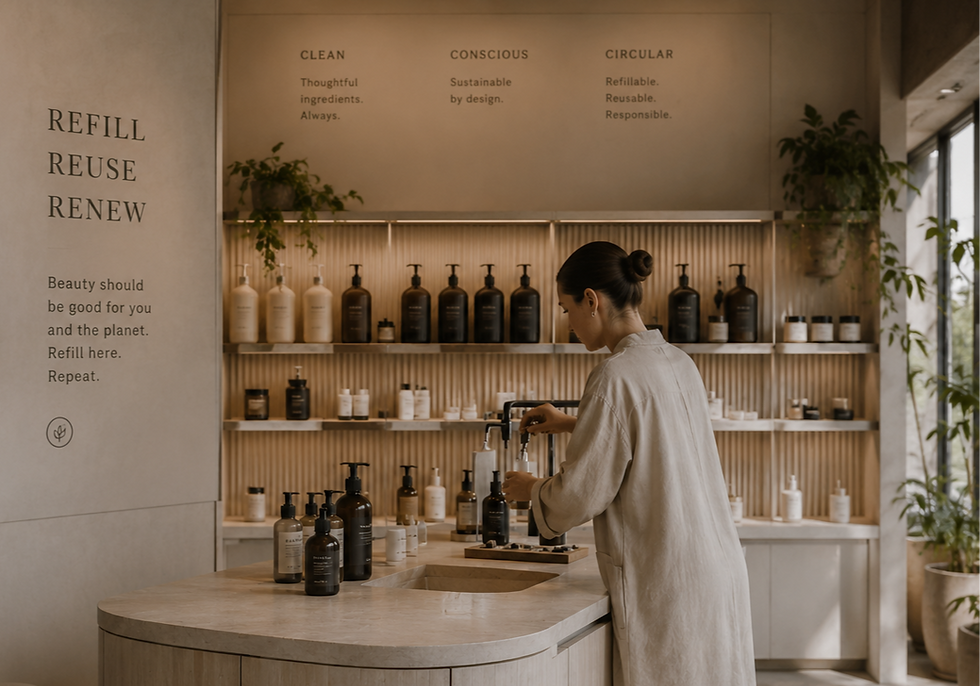
Beauty
Refill systems.
Reusable packaging.
Product take-back schemes.
Circular formulations.
Interiors
Furniture-as-a-service.
Repair ecosystems.
Product refurbishment.
Circular home solutions.
.png)
Opportunities
Resale Platforms
Second-life commerce becomes integrated into mainstream retail ecosystems.
Resale shifts from an alternative channel to a standard component
of product ownership.
Examples
-
Brand-owned resale marketplaces
-
Peer-to-peer resale systems
-
Automated valuation tools
-
Trade-in programs
Refill Ecosystems
Products are designed around continuous reuse rather than repeated disposal.
Packaging becomes a long-term asset rather than a single-use component.
Examples
-
Beauty refill stations
-
Smart refill subscriptions
-
Reusable packaging systems
-
Closed-loop delivery models
Circular Services
Brands generate value through maintenance, recovery and lifecycle management.
Business models increasingly focus on keeping products in use for longer.
Examples
-
Product maintenance plans
-
Recovery programs
-
Rental models
-
Lifecycle management platforms
Product Passport Systems
Digital records provide transparency throughout the product lifecycle.
Consumers gain access to information about origin, materials, repairability and environmental impact.
Examples
-
Digital product passports
-
Traceability platforms
-
Material transparency tools
-
Circularity verification systems